
From a distance the story writes itself.
Every October the southernmost city in the continental United States fills with painted bodies, headdresses the size of small furniture, and a reputation that travels farther than most of the people who actually show up. Headlines have called it a raunchy bacchanal. Travel copy has leaned on “anything goes.” Lifestyle glossaries have filed it as lifestyle-adjacent, a week when the streets themselves seem to wink. For people who have never been, ourselves included, the image is easy to hold: an island that briefly suspends ordinary rules and invites the rest of the country to watch.
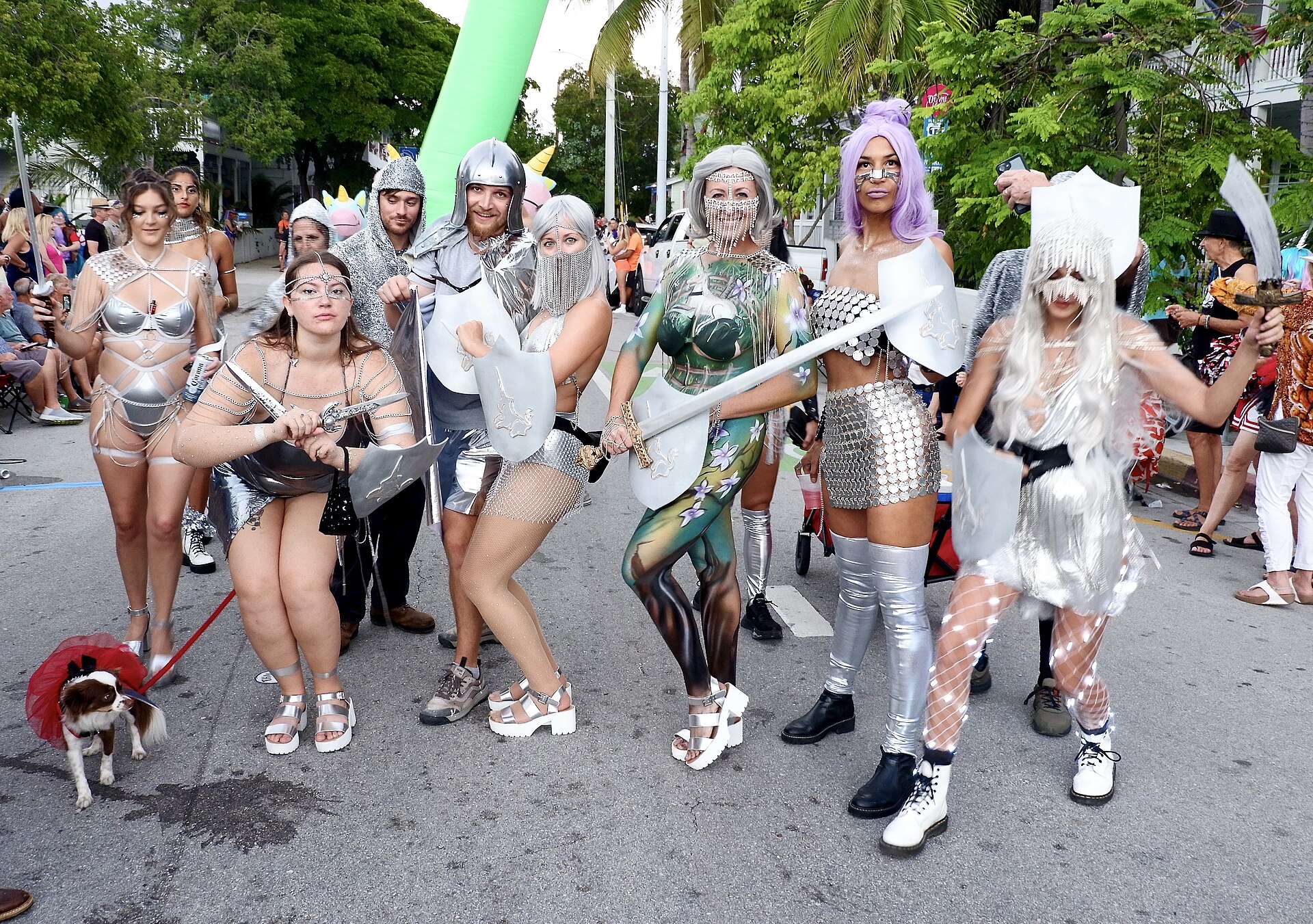
That image is not invented out of thin air. Body paint is real. A designated Fantasy Zone exists. Private parties with explicit themes appear on the calendar. Queer performance, fetish rooms, and the annual parade down Duval Street are all documented. The problem is not that the erotic charge is absent. The problem is that the charge has been allowed to stand in for the whole festival, as if a ten-day civic event were nothing more than the most extreme photograph that left it.
The more interesting story is how a commercial tourism rescue became a participatory public culture, and how that culture has spent decades arguing with itself about where the limits belong.
A party invented because the rooms were empty
Fantasy Fest did not begin as a manifesto of sexual liberation. It began as a fix for empty hotel rooms.
In 1979, Key West was dealing with the national gasoline crisis, water rationing after the desalination plant on Stock Island failed, and the ordinary seasonal drop that followed summer. Local business owners wanted bodies in restaurants and beds in October. Four local men organized a three-day event that borrowed civic machinery from New Orleans. Officials requested Mardi Gras ordinances. Commissioners waived open-container rules for the duration. Bar owners agreed to plastic cups. The first parade, reconstructed from old newspaper accounts, drew about seven thousand people along the route, short of the twenty thousand the organizers had hoped for, and included a silver-painted woman posed as a hood ornament on a black sedan among twenty-six floats.
They called it a party for grownups. That phrase has traveled. The original impulse was economic. A slow season needed spectacle. The spectacle they chose was masking, costuming, and a temporary, negotiated relaxation of certain street rules. From the beginning the festival was a public space with edges, not an absence of rules.
Themes followed. Early ones were local and theatrical, “Old Key West,” “House of Horrors,” “Va Va Voom.” Later a public contest replaced founder-only selection. This year’s theme is “Musical Icons and Iconic Musicals.” The grand parade steps off Saturday, October 24 at 7 p.m. The festival now runs ten days, October 16–25. Commercial language sometimes calls this the 47th edition. Counting calendar years from 1979 is different from counting editions actually staged. 2020 was canceled outright; 2005 moved to December after a hurricane. The safer phrasing remains “founded in 1979.”
Goombay arrived first
Before Fantasy Fest there was already a neighborhood festival.
Two years earlier, in 1977, a one-block celebration of Bahamian heritage began in Bahama Village. Organizers drew on migration history, ship salvage, architecture, music, and visual traditions that include Junkanoo elements carried to the Bahamas by enslaved Africans. The two festivals developed alongside each other while keeping distinct identities. Reducing Goombay to an exotic warm-up act for an adult tourist party erases the Black and Bahamian foundation of the cultural calendar.
In 2026 Goombay is listed free on the opening weekend, with its main stage at Petronia and Emma streets. Music, food, craft stalls, stilt-walkers, and community gathering remain the published texture. It is explicitly family-friendly in a way the rest of Fantasy Fest is not required to be. The distinction matters. Key West’s October is not a single aesthetic poured over the entire island.
The costume is the culture, and the rules are real
Body paint is the image most outsiders carry away. It is also the practice most carefully bounded by current organizer guidance.
Public nudity and lewd acts are prohibited. Body painting must take place in enclosed or screened areas out of public view. The official FAQ is explicit: pasties must be worn underneath body paint, and pasties and panties must remain on even while the paint is being applied. Painted-breast permission is limited to the designated Fantasy Zone, currently described as Duval Street from Front Street to Truman Avenue, with specific hours (generally 4 p.m. to 4 a.m., earlier on the final Friday and Saturday). Outside the zone, a cover-up is required. Open containers stay inside the zone; no glass. Backpacks, coolers, packages, water guns, weapons, and replica weapons are restricted.
These are not the rules of an anything-goes zone. They are the published conditions under which the temporary visual exception is allowed. Older reporting sometimes described wider boundaries or implied that paint alone was sufficient. Current official pages do not. The distinction between festival guidance and the full operative text of the municipal code is still a live legal question. What can be stated without overclaim is the organizer’s own published standard: coverings remain, the zone has edges, and paint is aesthetic practice, not a legal clothing substitute.
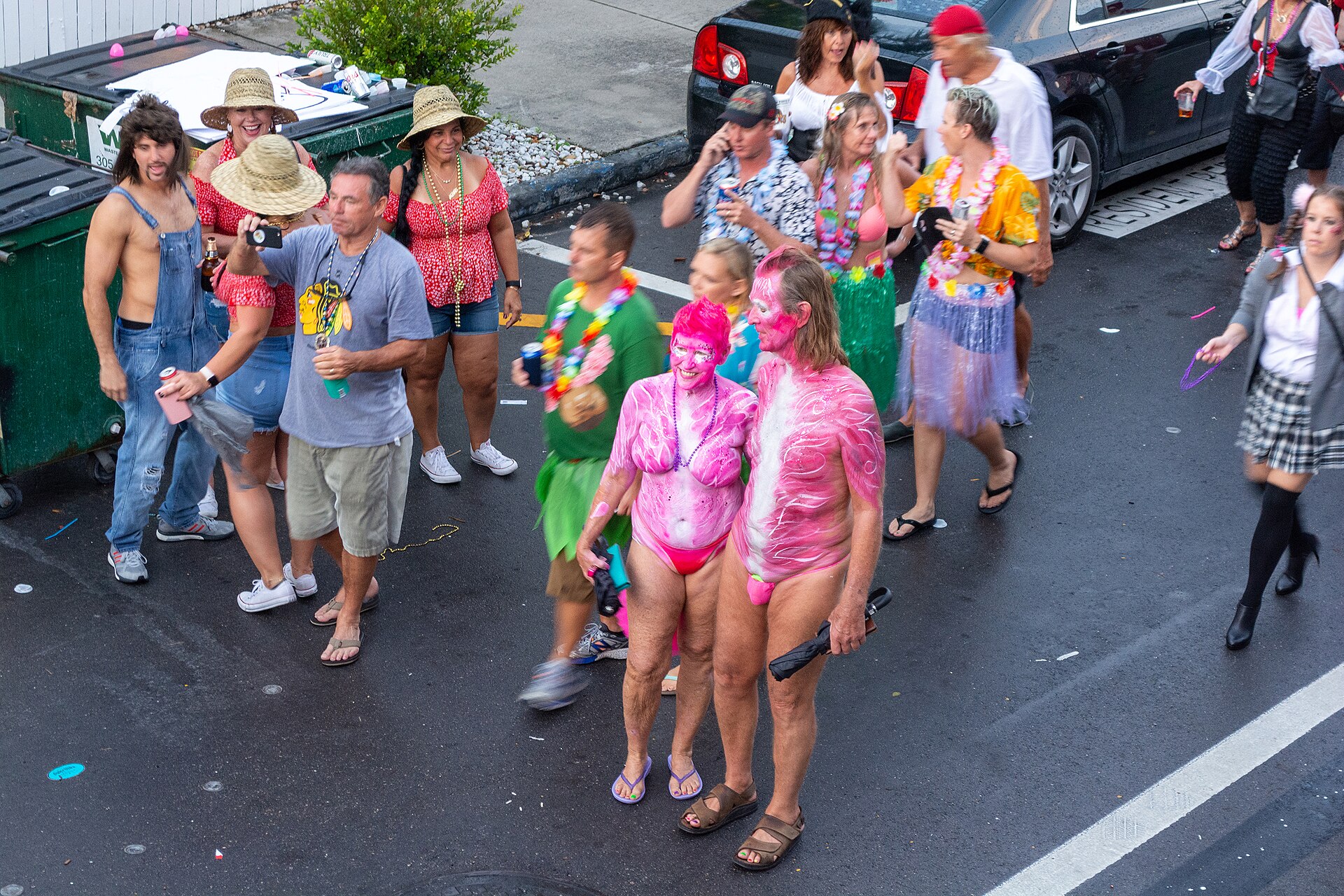
The labor itself is craft. One current listing places a body-art studio at Sunset Pier with small pieces starting at sixty dollars and waterproof options advertised. Full-body work is longer, more expensive, and more private than a quick street photograph suggests. Treating the painted body only as spectacle erases the hours of design, application, and the practical problem of how the finished surface travels through a crowded street under actual rules.
Queer performance and the crowns that raise money
Queer participation is not decorative background. It is programming.
Drag shows run through the week. The Headdress Ball, now in its fifth decade, turns elaborate headpieces into competitive art and fundraising. Men’s underwear parties and resort events appear on the private calendar. The island’s Business Guild frames the Ball as a celebration of artistic expression that also promotes Key West as an LGBTQ+ destination. Prize structures have been revised for 2026; the highest award is listed at $2,500 in the detailed announcement, though older ticket-platform copy has lagged.
The royal campaign is older and more specific. Since 1989, king and queen titles have gone to the highest fundraisers rather than to a conventional beauty contest. For decades the beneficiary was an AIDS-care organization. Local reporting puts cumulative fundraising above five million dollars by 2022. In 2023 the Florida Keys SPCA became both organizer and beneficiary. The 2025 court raised more than $350,000; the 2023 court helped fund a mobile spay/neuter/wellness clinic that was operating by 2025. The transition does not erase the AIDS-era origin of the campaign. It simply records that the same mechanism of extravagant self-presentation and competitive generosity can serve different community needs across time.
Pleasure and public contribution occupy the same cultural space here. That is one of the festival’s more durable and least-understood features.
The kink is on the calendar, and it is not the whole map
Fantasy Fest is not a dedicated swingers’ festival. Fetish clothing is not evidence of nonmonogamy. People come to watch floats, perform drag, join a tutu crawl, celebrate Bahamian culture, paint their bodies, raise money for animals, or attend a private party with explicit rules of its own.
The 2026 schedule does contain direct kink programming. One listed event advertises interactive BDSM stations, fetish rooms, and bondage, with the dress rule “No Kinky Costume – No Entry.” That listing is stronger evidence than an older travel writer’s characterization. It is also event-specific: age policy, consent monitoring, photography rules, and what is actually permitted inside the room are questions for the promoter, not inferences from the existence of the party.
A rooftop bar describes itself as clothing-optional and bans cameras and phones. Patrons may remain clothed. Clothing-optional status does not authorize public sex, grant photography consent elsewhere, or override street rules on the way there. Superlatives about it being the only such venue or the scene’s exclusive hub are not established by current public material.
The useful distinction is simple. A revealing costume is not permission to touch, photograph, follow, or proposition someone. Participation in one activity is not agreement to another. The festival’s own published rules already separate costuming from conduct. A careful reader can keep the same separation.
What the numbers measure, and what they do not
Attendance claims float between tens of thousands and six-figure forecasts depending on the year and the denominator. Parade spectators, overnight visitors, and total festival population are different counts. Tourism officials have credited the event with tens of millions of dollars in annual economic activity; published estimates have ranged around thirty to forty million in recent years. The underlying methodologies are not public in a form that allows precise reconciliation. The defensible public statement is the one that stays honest about the range and the limits of the data.
Disruptions are part of the record. A hurricane moved the 2005 festival into December. The 2017 festival went ahead after Hurricane Irma battered the Keys. COVID canceled 2020 outright, the first full cancellation, and forced a modified 2021 without the major parades and street fair. Full-scale programming returned in 2022, and with it the familiar public debate about nudity, traffic, sanitation, and commercialization. In 2023 organizers spoke of a new era of creative expression. The 2026 calendar still contains kink and burlesque listings. Neither a permanent “sanitized” narrative nor a permanent “anything goes” narrative survives contact with the actual schedule.
The city that keeps arguing with its own fantasy
The strongest version of Fantasy Fest is not the one sold by the most extreme photograph. It is the one in which a town invented a fall spectacle to fill rooms, borrowed civic rules from another city’s carnival, layered a Bahamian neighborhood festival that already existed, built a fundraising tradition out of queer performance and competitive generosity, and then spent nearly half a century negotiating how much of the resulting visual culture could spill onto public streets.
The media image is sticky because it is partial and dramatic. The working reality is messier and more interesting: zones with hours, pasties under paint, a free Goombay stage, a pet masquerade, a 5K for reef relief, a zombie bike ride, a children’s day in the park, and, yes, private parties that require a kinky costume for entry. The same city can host all of them in ten days and still argue every year about the edges.
We have never stood on Duval during the parade. We carry the same distant picture many readers carry. The record available in 2026 is clearer than the picture. Fantasy Fest is a costume city that keeps deciding, in public, what kind of fantasy it is willing to underwrite, and what kind of covering, zone, and consent the fantasy still requires.
That negotiation is the culture. The bacchanal was always the easier story.
Follow the festival
See our Fantasy Fest 2026 calendar listing for the event reference, and the organizer’s live schedule for current programming. Schedules and venue policies can change.
Reporting and image notes
This feature is based on published records reviewed October 17, 2026. We have not attended the festival or conducted original interviews for this piece. Organizer guidance is reported as guidance; the full municipal code is not independently interpreted here. The photographs show earlier festivals, not the 2026 event.
Photographs: Key West Masquerade Parade, Fantasy Fest 2023, by Cayobo, and Fantasy Fest Masquerade March in Key West, 2019, by Matthew Dillon, via Wikimedia Commons. Both licensed CC BY 2.0; resized copies, no editorial alterations.
Sources
- . Fantasy Fest 2026: Musical Icons and Iconic Musicals. Key West Tourist Development Association, . Accessed 2026-10-17.
- . 2026 Schedule of Events. Key West Tourist Development Association, . Accessed 2026-10-17.
- . Fantasy Fest Parade: October 24, 2026. Key West Tourist Development Association, . Accessed 2026-10-17.
- . Frequently Asked Questions: body painting and public decency. Key West Tourist Development Association, . Accessed 2026-10-17.
- . Code of Conduct: Fantasy Zone boundaries and hours. Key West Tourist Development Association, . Accessed 2026-10-17.
- . Keys History: The origin of Fantasy Fest. Keys Weekly, .
- . Before Fantasy Fest, there was Goombay. Keys Weekly, .
- . Key West Business Guild reinvents iconic Headdress Ball with more prize categories. Keys Weekly, .
- . Key West crowns Fantasy Fest king & queen. Keys Weekly, .
- . New Fantasy Fest Royal Court Crowned on Friday night. Key West Chamber of Commerce, .
- . King and Queen: royal campaign and 2025 fundraising results. Fantasy Fest, . Accessed 2026-10-17.
- . Garden of Eden: clothing-optional venue and camera policy. The Bull & Whistle Bar, . Accessed 2026-10-17.
- . Key West’s Fantasy Fest ends with increased emphasis on costumes. WLRN, .
- . Fantasy Fest parade caps 10-day Key West festival. NBC Miami, .
- . Fantasy Fest returns to Key West after Hurricane Irma. WTOP, .
- . Fantasy Fest returns to Key West after COVID shutdowns. WFIT, .



Member conversation
Comments
Comments are available to signed-in Voyeur members and above.
Sign in