
Most nights begin with a vague agreement to touch and see what happens. Sensation mapping replaces that vagueness with something more deliberate. The map is not a checklist of erogenous zones. It is a real-time conversation between different qualities of touch and the nervous system that answers them.
When the map is working, ordinary touch becomes electric. The room goes quieter. Breath deepens. The energy of the night shifts from conversational to charged without anyone needing to announce that sex has begun. The map itself becomes the foreplay.
Why the body answers differently to different touch
Skin is not uniform, and touch is not carried by one simple pleasure pathway. A 2023 review of C-tactile afferents concludes that these fibres support gentle, affective touch, while also cautioning that not every affective or pleasant touch experience depends on them. Pressure, temperature, texture, attention, and context all contribute. Mapping is our practical way of varying those qualities and noticing what this body does now, not a neurological test.
Large body-mapping studies have found broad patterns as well as individual variation in reported erogenous sensation. The 2016 Topography of Human Erogenous Zones survey mapped self-reports rather than predicting what any one person would enjoy. That is the practical reason we ask and map rather than assume.
A sequence we return to
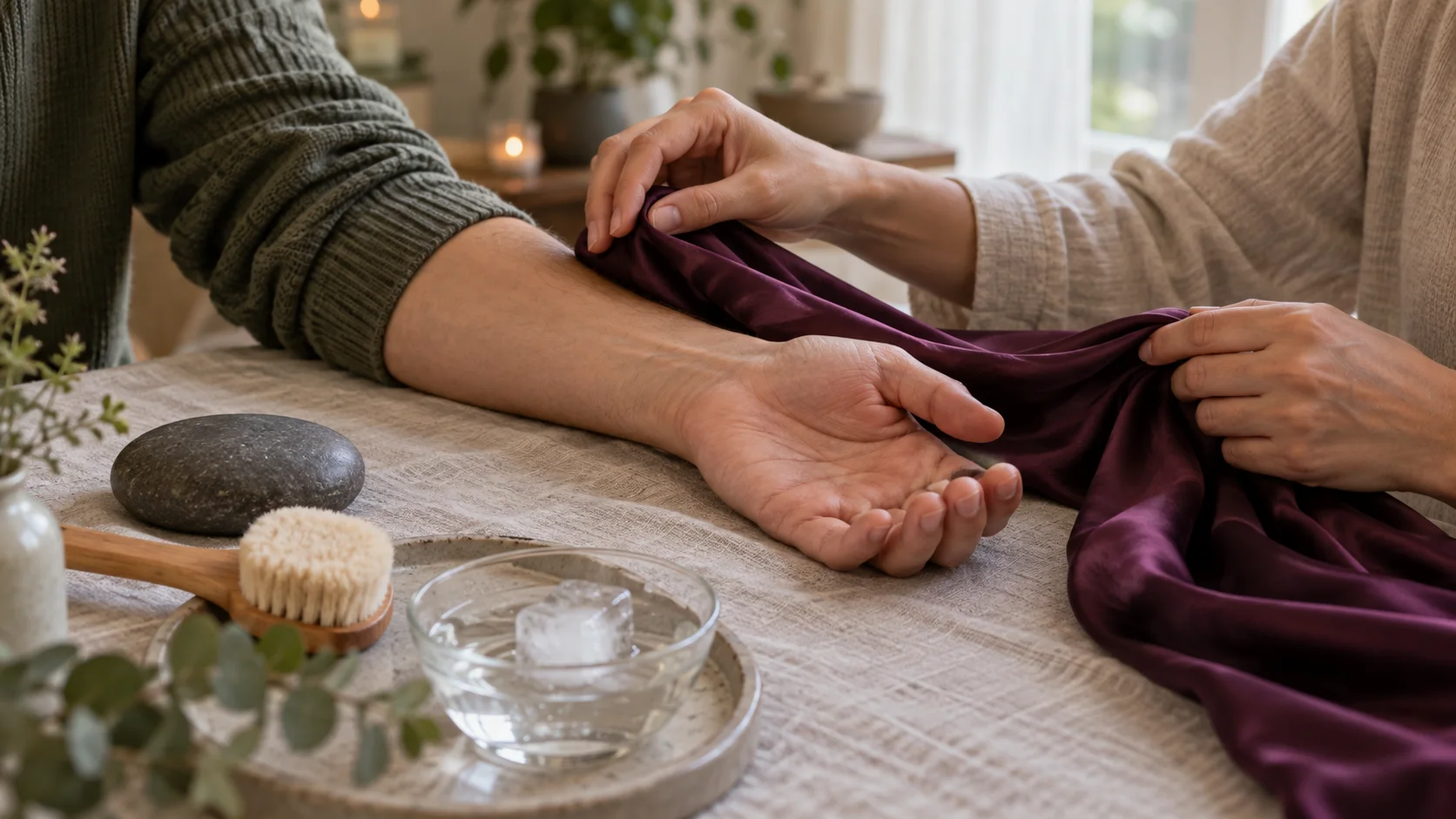
We start simple and stay patient. Temperature first: warm hands on cool skin, then a brief trail of ice that moves continuously across the lower back. Texture next: the soft side of a silk scarf across the insides of the thighs, followed by the light scratch of a fingernail. Pressure moves from barely there to firm enough to leave a temporary bloom of colour. Location travels deliberately - the soft place behind the knee, the outer edge of a breast, the hollow just above the pubic bone.
Each quality is named quietly as it arrives. “Warm.” “Cool.” “Soft.” “Firm.” Naming helps the body and the partner learn the map together rather than guessing.
One sequence we come back to often begins with cool breath across the neck, then the flat of a palm with medium pressure down the spine. We switch to the textured side of a soft brush along the ribs, then firm fingertip pressure at the crease of the hip. Temperature contrast follows - warm mouth after cool air. We stay on non-genital zones long enough for the nervous system to wake fully before the map travels lower.
When the right combination lands, the shift is unmistakable. The whole body softens and then sharpens at the same time. The night’s energy changes.
“When we hit the right combination the energy shifts. The room goes quieter, my breath deepens, and ordinary touch suddenly feels electric.”
What the body feels when a zone lands
For the person receiving, a mapped zone that lands correctly can feel like a warm current under the skin, then a sudden bright focus that makes the rest of the room fade. Breath catches. Hips answer without permission. A liquid heat spreads from that single point. It is not orgasm yet. It is the body saying yes, here, more of this.
For the person giving, the feedback is visible and tactile. Breath changes. A small arch of the back appears. A muscle softens or tightens under the hand. Responses become clearer and faster. Fewer words are needed. The space between the two bodies grows heavier, quieter, more magnetic.
“It’s not orgasm yet - it’s the body saying ‘yes, here, more of this.’”
That feedback is how we know we are building something real rather than simply touching.
Keeping the map felt rather than listed
We mark a good zone with a soft sound or a lingering touch that simply says “this one.” Returning is a deliberate revisit with a slight change - more pressure, slower speed, or the addition of breath. Escalation is mostly non-verbal: a hand covering the partner’s and pressing firmer, or a quiet “right there” that is more moan than instruction.
It never feels like a list because we stay inside the sensation instead of standing outside it naming categories. A longer pause on a spot is often enough of a mark. Spoken cues stay minimal and present.
“It never feels like a list because we stay inside the sensation instead of outside it naming categories.”
First play dates: the massage as map
With new partners we often begin with erotic massage rather than diving straight into genital contact. A slow upper-body or full-body massage on a first play date gives us clean data. We learn how someone’s body answers temperature, pressure and texture before the night has to decide what it is becoming.
We both love this approach. It removes performance pressure. It gives the receiving person time to notice and name what feels good. It lets us distinguish verbal responses from purely physical ones. Some people talk easily - “firmer there,” “that’s perfect.” Others go quiet and answer only with breath, a hip shift, or a change in muscle tone. Both kinds of response are valuable. The map records both.
We keep the massage exploratory rather than goal-directed. Hands move with the same quality of attention we use in private mapping: slow enough for the nervous system to register, varied enough to sample different receptors, long enough on promising zones to confirm the response. Consent stays active and reversible the entire time. The massage can stay a massage. It can also become the doorway into more explicit contact once the map has spoken.
This is especially useful in soft-swap or early lifestyle contexts. Everyone can remain clothed or partially clothed as long as they want. The information gathered travels with us into whatever the night becomes.
Mapping in a small group
The same principles can scale, but more hands add more communication and sensory load. In a small, trusted group, pairs can form for a timed window - ten to fifteen minutes of mapping, then roles reverse. Temperature, texture and pressure tools can be shared. Feedback stays optional and low-volume: a soft sound, a hand guiding the partner’s hand, or a single word.
Another format has one person receiving while two or three others map different zones simultaneously, always checking in and never crowding. The receiving person can name what is landing or simply let the bodies answer.
A few rules keep it clean. Clear time boundaries so no one feels trapped. Explicit permission to stop or change the quality of touch at any moment. Agreement that genital contact is either off the table for the exercise or requires a separate, explicit invitation. Aftercare space once the mapping ends - water, quiet, or private reconnection as needed.
Used this way, the map becomes a shared language rather than a private skill. New partners learn each other faster. Existing partners discover new zones or new responses. The group energy stays exploratory instead of performative.
When the map stalls
The most common stall is rushing the non-genital zones or over-focusing on a single hot spot too early. Another is one person starting to think ahead to the “main event.”
Recovery is simple. Drop back to breath and a neutral, safe zone - shoulders or outer arms - until the nervous system settles. Then rebuild slowly. A soft laugh and “let’s start again here” keeps the mood intact. Stepping back to broader, slower touch and re-establishing temperature or texture contrast also works.
“We treat the stall as information, not failure.”
Having a shared, low-stakes reset phrase in advance keeps the map playful rather than pressured.
The map as the architecture of the night
Sensation mapping is not a warm-up that ends when “real” sex begins. It is the structure of the night. Temperature, texture, pressure and precise location, layered slowly and named, create a body that is already awake and already answering before any genital contact is required.
When the map is working - whether between two people who already know each other, on a first play date, or as a group exercise - the night does not need to declare its intentions. The energy has already shifted. Ordinary touch has already become electric. The rest of the evening simply continues the conversation the map began.
Sources
- . What are C-tactile afferents and how do they relate to “affective touch”?. Neuroscience & Biobehavioral Reviews, .
- Topography of Human Erogenous Zones. Archives of Sexual Behavior, .

Member conversation
Comments
Comments are available to signed-in Voyeur members and above.
Sign in