Before We Walk You In
You've done the hard part already. You found each other on the site. You messaged. You met for dinner—twice—and liked them. They passed your strict vetting process. You and your partner have had the real conversations: the fantasies, the boundaries, the "what ifs." You've agreed: same room, always. Protection for penetration, always. A swap if it flows, no pressure if it doesn't. You've done your individual gut-checks and you're both green-lit, a little nervous, and—let's be honest—more than a little turned on.
This guide picks up where the planning ends and the evening begins. The doorbell. The drinks. The first touch. The check-ins. The heat. The finish. The soft landing after. And the unexpected bumps along the way.
One idea holds the whole night together, so let's say it plainly before anything else:
“Consent isn't a gate you pass through at the start of the night. It's the current running under everything—and when you learn to speak it out loud, it doesn't kill the mood. It is the mood.”
"Can I kiss you?" whispered an inch from someone's mouth is one of the most erotic sentences in the English language. You're about to find out why. Desire plus deliberate care — that combination is the foundation everything else in this guide stands on.
Chapter 1 · Before They Arrive
The Last Thirty Minutes
Turn what you know, what you want, and what your home needs into one calm shared plan.
Confirm that the invitation was earned
An invitation into your home should come after more than chemistry. Before this point, you should have verified that the couple is who they say they are, met in a public place, watched how they receive a small no, discussed relationship structure and experience honestly, and noticed whether both people speak with equal freedom. Ask about privacy, sexual-health conversations, substance use, transportation, expectations, and what happens if only one person wants to continue. References or platform verification can add context; neither replaces your judgment.
Recap the people, not just the plan
Take five minutes together and refamiliarize yourselves with these particular guests. Revisit their profile and skim your recent messages so one couple does not blur into another. What did each person say they wanted? What did each decline or leave as a maybe? Who tends to answer first? Note a recent trip, work change, hobby, joke, or story you can ask about; remembered details make ordinary small talk easier. Also recall any need for extra time, reassurance, accessibility support, discretion, medication timing, or an alcohol-free option. Keep what they actually said separate from what you inferred.
Optional activity—Make the guide yoursiNames stay only in this open page. They are not transmitted, stored, or placed in a cookie; refresh to restore Dan and Kate.
Replace Dan and Kate with your guests’ names throughout this page.
“We are not trying to build a dossier. We are reminding ourselves who is about to ring the bell—the details they trusted us with, the things happening in their lives, and the questions that will help them feel remembered rather than processed.”
Recap your limits and expectations
Now bring the attention home. This is a joint exercise, but it begins with two individual answers. Each of you names what feels open, what requires a fresh conversation, and what is closed tonight. If one of you welcomes kissing and the other does not, kissing is not part of the couple’s shared open list. Build tonight’s plan at the more conservative edge, then remember that even a shared green still requires each person’s consent in the moment.
Confirm the same-room agreement, barrier plan, substance limit, photography and phone rules, sleeping or departure expectations, and what counts as a wonderful evening if play never begins. Earlier agreements are a starting point; neither partner owes tonight’s version of a yes.
Set tonight’s edgesCompare individual comfort, then write the shared plan you can both support.iNothing entered here is saved or transmitted. It disappears when this page closes or refreshes. This exercise supports a conversation; it never replaces anyone’s in-the-moment consent.
Do this together: each partner first says what feels different tonight. Where your answers differ, use the narrower limit in the shared fields below.
What to do when your limits differA practical way to protect tonight without avoiding the larger conversation.
Thirty minutes before guests arrive is not the time to persuade your partner into a wider boundary. Thank them for saying what is true, ask only what you need to understand the limit, and set the shared plan at the narrower edge. Say it plainly: “Kissing is closed for us tonight,” not “she is the one who does not want kissing.” Presenting the boundary as joint protects your partner from pressure and keeps guests out of your relationship negotiation.
- Name the difference without litigating it. “I am open to oral tonight; you are not. I hear that.”
- Choose the shared edge. Anything that is not comfortable for both partners moves to ask-first or closed.
- Find the evening that still works. Name what remains genuinely welcome rather than treating the narrower plan as a loss.
- Schedule the deeper talk. Revisit recurring differences later, when nobody is waiting at the door and either partner can think without social pressure.
“Amanda and I genuinely differ in some of our limits with other people. Understanding why gives us somewhere useful to begin: sometimes it is confidence or desire, sometimes a cultural story we absorbed, and sometimes it is simply today. A sore tooth can take kissing and giving oral off my list; a stressful day may make Amanda want to receive rather than give. In the last thirty minutes, we are checking current conditions—not writing a permanent rule for every couple or every encounter. We play at the more conservative edge, appreciate what is available tonight, and save the bigger conversation for later.”
Prepare the home for dignity and choice
Set warm lamps rather than harsh overheads and choose music that can hold a silence without demanding attention. Clear the route to the bathroom and play space. Put fresh towels, tissues, unscented wipes, water, appealing alcohol-free drinks, snacks, clean bedding, a visible wastebasket, barriers, compatible lubricant, and toy-cleaning supplies within easy reach. Secure medications, valuables, identifying mail, children’s items, cameras, and anything private. Agree where phones will live. Make the temperature comfortable for people who may be partly dressed, and leave enough clear space that anyone can move away without climbing over another body.
Preparation is not stage direction. It removes small logistical pressures so a pause can remain a pause, a request for water does not become a production, and nobody has to search a stranger’s cupboards while vulnerable.
Practice the private doorway
A private signal gives your partnership a quiet doorway into a spoken check-in; it is not silent permission to continue and cannot answer for either guest. Choose cues that are distinct from ordinary affection: two deliberate hand squeezes for “check on me,” a hand placed flat on your own chest for “slow down,” eye contact followed by a nod toward the kitchen for “we need privacy,” or the spoken phrase “Can you help me get some water?” Use plain shared words such as yellow, pause, red, and stop whenever subtlety could be missed.
Taking a private pause is responsible, not embarrassing. “You should have figured this out beforehand” and “We thought you were experienced” are not reasonable responses to a check-in; they are pressure. Guests who cannot respect communication may not be the right guests for this connection. Extend the same respect in return: if your guests ask for a moment alone, show them where they can talk, give them real privacy, and do not hover, speculate, or demand an immediate answer.
Rehearse your private signalsGive reassurance, slow-down, private-pause, and stop cues a shared meaning—and a verbal backstop.iNothing entered here is saved or transmitted. A private couple signal cannot grant consent for another person or override anyone’s spoken or nonverbal stop.
“Before the doorbell, we set the lights and music for us—the mood exists before the guests do. We talk through our nerves, our green lights and reds, and what we know about this couple’s yeses and nos. And we touch. That is where anxiety turns into anticipation—with each other, before anyone else arrives.”
Research and further reading: New Swingers Guide, finding and vetting people; arrival checks and consent in motion; CDC condom use and material compatibility; Mallory (2022), sexual communication meta-analysis.
Chapter 2 · They Arrive
The Welcome
Make the room safe enough for everyone to become curious.
The lighting is already low and warm, the music is carrying the empty spaces, and everything anyone might need is easy to find. Then the doorbell rings. Dan and Kate cross from people you have been anticipating into people standing in your home. Everyone knows why they are here; nobody needs the foyer to carry the full weight of that knowledge.
Your first task is not seduction. It is helping four nervous systems arrive in the same room. Let coats come off, show them the bathroom, offer a drink, and give conversation somewhere ordinary to begin. The distance between the couples does not need to close yet.
Your job in the first ten minutes
Here's a piece of first-hand truth from couples who've hosted many of these nights: the first ten minutes set the ceiling on the whole evening. Not because anything sexual happens — because safety happens. Dan and Kate are guests in your home, on your turf, and they are exactly as nervous as you are. Probably more. A relaxed guest becomes an enthusiastic playmate. A tense guest goes home early.
So your only job at the door is to be warm. Not smooth. Not seductive. Warm.
Do
- Greet them the way you'd greet good friends—hugs if that's been your pattern at dinners, held one beat longer than a polite hug. Not gropey. Just present.
- Offer water and several drink choices, including appealing alcohol-free ones. A glass can be a social prop; alcohol itself is not the point.
- Give the two-minute tour. Show them the bathroom and casually include wherever play might happen: "That's the bathroom, that's the bedroom—make yourselves completely at home." You normalize the whole house without a loaded announcement.
Don’t
- Don't lead with innuendo at the door. A joke like "ready for the big night?" lands like a wet towel. Everyone knows; nobody needs it announced in the foyer.
- Don't apologize for nerves on a loop. One light acknowledgment later is charming; repeated narration spreads anxiety.
Say things like
- "We've been looking forward to this all week." True, warm, and honest about anticipation without pressure.
- "House rule: nobody's a guest after the first drink. Fridge is yours."
- "You two look fantastic." Say it to the couple early, before complimenting either person individually.
- "Come in, get comfortable—there is absolutely no schedule tonight."
- "Would you rather settle here first, or have the quick house tour?" Even a tiny choice gives guests some agency in a new space.
♂ For Him: Your instinct may be to perform — be the funny host, fill silences, top up drinks every four minutes. Ease off about 20%. Nervous men talk at people; confident men ask questions and actually listen to the answers. If Dan makes a self-deprecating joke about nerves, meet it with an easy laugh and a matching admission if it's true: "Yeah, we're both a little wired too." Male-to-male ease lowers the temperature for everyone — and Kate will remember that you asked about her week and listened. That memory does more for later than any joke.
♀ For Her: You likely hold the emotional thermostat of this room, whether that's fair or not. The single most powerful thing you can do early is make warm eye contact with Kate and get her laughing. When the two women in the room are relaxed and having fun, everyone exhales. If Kate seems quieter or more contained, hand her an easy on-ramp: "What have you two been most looking forward to about tonight?" — a question that lets her set her own pace of disclosure. If you're nervous, tell your partner with a squeeze of his hand — not the room.
Keep awareness available
If you want a drink, enjoy one; alcohol is never required. Then slow way down.
You want the edge off, not the awareness off — for two reasons. First, everything later depends on reading body language and hearing soft-spoken words, and alcohol dulls exactly those instruments. Second, and this is non-negotiable: consent given under heavy impairment is not reliable consent, and a very drunk person's "yes" is not one you want. Decide before the evening how much is enough for each of you, and hold the line. If anyone's speech, balance, or eye focus changes noticeably, slow the entire evening down or stop. If anyone gets past tipsy, the night becomes a dinner party. A fun one. But a dinner party.
Keep water on the table without comment. Refill it like it's nothing.
Research and further reading: New Swingers Guide, arrival checks and consent in motion; Lexicon: consent; Mallory (2022), sexual communication meta-analysis.
Chapter 3 · Settle In
Small Talk, and the Art of Warming It Up
Let ordinary conversation, visible affection, and honest words turn up the temperature together.
Scene ReminderReturn to the room before you think about crossing it.
It is your home. The lighting is low and warm—lamps, not overheads. A playlist hums at a volume that fills silence without demanding attention. There are drinks and snacks on the coffee table that nobody is really eating. All four of you are on the sectional, each beside your own partner, with clear space between the pairs. Everyone knows why they are here, and nobody has said it yet.
You are not sitting close enough to touch. Not yet. Good. Your job is not to close that gap by force. It is to keep the temperature warm, lower the collective pulse enough that people can breathe, and create soft openings anyone can step through—or step back from—without losing face.
You're all on the sectional now. The conversation is easy — you already like these people. So how does an evening move from "how was the drive?" to hands in each other's laps without a horrible clunk?
It moves in three gears. Let it.
Gear one: normal talk, closer bodies
Keep the conversation ordinary and let proximity do the early work. Ask about the drive. Revisit stories from the dinners you've shared. Then let the questions drift toward the shared present. Refill drinks and sit back down slightly closer — to your own partner first. Put your hand on your own partner's thigh. Play with her hair. Let Dan and Kate see you two being affectionate.
This is the most underrated technique in this whole guide: the first flirtation of a swap night is between the original couples. Watching you kiss your own wife's neck gives Dan and Kate permission to warm up too — and nothing reassures a nervous couple like seeing that their hosts genuinely desire each other. Nobody wants to play with a couple who seem to be escaping their marriage. Everybody wants to play with a couple who are clearly hot for each other and generous with it.
Watch bodies, not just words. People who are opening up angle their torsos toward the other couple, uncross their arms, allow longer eye contact, let their hands rest open. People still protecting themselves stay tightly oriented toward their own partner, fold their arms, or find small tasks — phone, drink, snack — to occupy their hands. Treat those signals as information, not as a problem to solve. Don't push past them.
♂ For Him: Keep physical contact with your own partner — a hand on her thigh, your arm along the couch back behind her, leaving the outer side of your body open toward the other couple. That small anchor does two jobs at once: it reassures her that you're still with her, and it signals that you two are a unit choosing to open, not a pair drifting apart. When conversation pauses, let your gaze rest on Kate a beat longer than polite rules usually allow, then smile. A low "You look really good tonight" with steady eye contact is often enough to start the shift.
♀ For Her: Lean into your partner. Laugh with your head on his shoulder. Cross your legs toward the other couple — toward, not away. These can signal openness, but they are not consent and they are never risk-free substitutes for asking. If Dan offers a compliment, a soft "Thank you… that actually feels nice to hear" keeps the door open without rushing through it.
Gear two: naming the undercurrent
Someone has to tilt the conversation from the office renovation toward this. The smoothest route is talking about the situation itself — with warmth and a little humor. Naming the undercurrent stops it being an invisible weight; most people feel relief when someone else says the quiet part first.
The first real check-in — pick your register:
- Mild: "I'm really glad you both came. This already feels good."
- Direct: "We've been looking forward to this all week. How are you both feeling now that you're actually here?"
- Explicit: "I'm a little nervous and a little turned on sitting here with you two. You?"
More doorways, if you want a running start:
- "Can I ask you two something? What made you finally set up the profile?" (Their origin story. Couples love telling it, it's inherently intimate, and it's basically a highlight reel of their desires.)
- If you're all first-timers: "So are we actually all new at this? Because you two seem suspiciously calm."
- The gentle classic: "So… what are you two hoping tonight looks like?"
That last one is the doorway. Say it with a smile, holding your own partner's hand. It's a real question and it deserves the room's attention, because the answer is where consent starts becoming explicit instead of assumed.
“Peter waits for a natural opening—an innuendo already floating in the room—and leans into it with humor. The craft is not the line; it is the space after it. The other couple can run with it or let it drift past, and nobody loses face. The tilt always ships with an exit ramp.”
“I like a doorway that leaves the exit visible. Asking what everyone hopes tonight looks like can open the erotic conversation, but it also makes room for ‘mostly talking,’ ‘not sure yet,’ or ‘less than we imagined.’ The answer does not have to reward the person brave enough to ask.”
Gear three: the desire conversation (this is the sexy part, we promise)
When the topic is finally the four of you, you're going to do out loud what you've been doing online for weeks—talk about interests and boundaries—but now it's electric, because everyone you're describing is in the room. Online, a wish can remain pleasantly abstract: you have time to edit the sentence, a shared profile can make two people sound like one voice, and a shy partner can let the more confident texter carry the exchange. In person, the words belong to actual bodies sitting within reach. Tone, hesitation, excitement, and the difference between two partners become visible.
Make room for everyone to contribute something in their own voice. That does not require equal airtime, identical confidence, or an intimate confession on demand. It means slowing down enough to notice who has not spoken, asking without putting them on display—“Kate, is there anything you want us to know from you?”—and letting “I need a minute to think” count as a complete answer. Hosts can lower the stakes by going first: each of you name one desire, one boundary, and one uncertainty. Shyness is not disinterest, but it is also not permission for a partner to answer on someone else’s behalf. The goal is a four-person understanding built from four recognizable voices.
“I often name one thing I want and one thing I do not want before asking anyone else. Going first makes the question feel reciprocal instead of like an interview.”
“I listen for whether each person answers for themselves. The goal is not four identical lists; it is a plan in which nobody disappears behind their partner’s confidence.”
Someone should lovingly summarize the ground rules. As hosts, that's your privilege:
"So — you know from our messages, we're a same-room couple. That's our thing, we like being together for it. And we're a condoms-always couple. Beyond that… we're pretty open to seeing where the night goes. What about you two — anything that's a no for you, or anything you're really hoping for?"
Look at what that little speech accomplishes. It states your hard limits without apology and without drama. It frames boundaries as preferences that make the night better, not restrictions that make it smaller. And it hands Dan and Kate the floor to do the same.
Then ask the fun version of the consent question:
- "Kate, what do you like? Like — actually like?"
- "Dan, is there anything she's amazing at that we should know about?" (Watch a couple light up bragging about each other. It's disarming and hot.)
- "Anything that's an absolute yes for you tonight?"
- "What is one thing you would love to be asked for later?"
- "If tonight had a highlight reel tomorrow, what moment would you hope made the cut?"
Keep the conversation moving in gentle loops. Short, comfortable silences are useful; they let the undercurrent rise without anyone forcing it. By the end of this stretch you're still with your original partners, still clothed, still technically in "social" mode — but the distance between the two couples should feel less like a wall and more like a space that could be crossed when someone is ready.
The Question We Now Always Ask
“What does a great first playtime look like for you—versus a third?”
We ask because it aligns expectations before bodies are involved and makes our intentions clear: we are interested in ongoing connections, not one-night stands. A first night does not have to prove everything. Mutual understanding gives everyone the freedom to move as quickly or as slowly as they want, while leaving room for trust, comfort, and the experience itself to grow over time.
Research and further reading: Mallory (2022), communication quality and satisfaction; New Swingers Guide, consent in motion; Lexicon: aftercare.
Chapter 4 · Cross the Gap
Closing the Gap, and the First Touch
Create an opening, ask cleanly, and make every answer easy to give.
There is a moment in every one of these nights — you'll feel it — when the conversation gets slower and lower, sentences land and leave longer pauses behind them, the eye contact holds a half-second too long, and everyone is waiting for someone to be brave.
Be the brave one. That pause is your window. The move from sitting apart to sitting close enough to touch should feel gradual, almost inevitable — never sudden or staged. Here are three bridges, in ascending order of directness. Use the lowest gear that works.
Option 1: The game
Old-fashioned for a reason. "Should we play something?" A familiar game can create reasons to laugh, disclose, or invite a small step without making escalation the price of playing. Keep every turn optional and agree that completing one prompt never implies yes to the next.
Optional activity—Choose a playful bridgeDraw a truth or dare, or choose a lower-pressure game.iThe random draw happens only in your browser. Every prompt is optional: redraw, adapt, or decline without explanation.
Set the rules first: anyone may pass, trade a prompt for a milder one, or stop playing without explanation. Try truth or dare, never have I ever, strip poker with “keep, pass, or substitute” rules, adult charades, or a conversation deck. Commercial options include Kheper Games’ adult party games and We’re Not Really Strangers; these are examples, not endorsements, so check current contents and player counts.
Option 2: The partner kiss
You kiss your own partner. Properly — slow, unhurried, five seconds, ten. In front of them. Then you break, look over at Dan and Kate with a smile, and one of you says:
"Don't mind us. Feel free to join in… with each other, we mean. Or…" (a little grin) "…however."
Playful, low pressure, and it puts real desire in the air. Dan and Kate may kiss too, they may watch, or they may laugh and keep talking; all three answers keep the room honest. If they do join, there are suddenly two couples making out on one sectional—a completely different room than the one you were in ninety seconds ago.
Option 3: The direct ask (the gold standard)
Sometimes the honest move is the smooth move. Verbal bridges, by register:
- Mild: "Come sit closer if you want. There's plenty of room."
- Direct: "I'd like to be able to touch you both. Is it okay if we move in a little?"
- Explicit: "I'm getting turned on just sitting here with you two. Can we close the gap?"
Or the fully brave version. She looks at Dan: "Dan, would you come sit next to me?" He looks at Kate: "Kate — can I kiss you?"
"Can I kiss you?" Learn to love that sentence. Said quietly, close, with your eyes on hers — it is not a bureaucratic formality. It's foreplay with a safety mechanism built in. The asking is the seduction: it says I want you, and your yes matters to me — the most attractive combination of messages a near-stranger can send.
Confidence, desire, and the words that still leave a choiceDoes asking make attraction weaker—or can the question sound like want?
Some flirting advice aimed at men treats permission as hesitation: the confident man supposedly acts or declares, while the uncertain man asks. That advice is built on a familiar heterosexual script—men initiate and direct; women receive and regulate access—not on evidence that women universally find consent questions unattractive. Research does show that people worry direct consent will feel awkward, interrupt momentum, reveal inexperience, or invite rejection. Those concerns are real social experiences. They are not proof that ambiguity is more attractive.
In two experiments using written erotica, readers rated scenes with explicit verbal consent about as sexy as scenes without it; in one comparison, the consent version was judged slightly sexier. The study tested stories, not live dates, and cannot identify one universally attractive sentence. A separate qualitative study found both barriers and rewards: some participants described direct language as awkward, while others linked it with clarity, respect, trust, better sexual communication, and even enhanced sexual quality. The researchers suggest fluency matters—language can feel smoother when people have practiced using it.
The strongest version combines direction about your desire with uncertainty about their answer. “Can I kiss you?” can be confident when your voice and body clearly communicate want. “I’d like to kiss you” names desire, but by itself it does not ask whether the other person wants the kiss. Try: “I’d really like to kiss you. Would you like that?” or “I want to kiss you—may I?” The first half leads; the second leaves a real door open. Confidence is not pretending you already know the answer. It is being willing to state what you want, hear what they want, and remain composed either way.
Be wary of gendered formulas that make one person the permanent pursuer and the other the gatekeeper. Research on sexual scripts links more traditional gender stereotypes with lower expectations to ask for, refuse, or honor consent. In this room, every gender gets to initiate, desire, ask, answer, redirect, and stop.
Piemonte et al. (2020), explicit consent in written erotica · Edwards, Rehman, and Byers (2022), perceived barriers and rewards · Rodgers et al. (2023), gender scripts and consent expectations
The first deliberate touch
Once the gap has narrowed, the next layer is light, non-genital touch — still over clothes. A hand resting on a thigh. Fingers brushing an arm. A slow, deliberate stroke of hair away from a face. The first time you cross from social space into intentional touch, pair the action with a clear, low-pressure check:
"I'm going to put my hand on your leg. Tell me if you want it somewhere else — or if you want me to stop."
Then do exactly that. Wait. Watch their response and care about the whole room. Their partner's expression may prompt a check-in, but only the person being touched can answer for their body.
♂ For Him: When you initiate with Kate, keep your own partner in peripheral vision or in light contact. Eye contact with Kate plus a quiet "May I?" before the first deliberate touch is powerful and grounding. If she leans in, covers your hand with hers, or answers with a clear yes — continue, and stay at that level longer than your impatience wants. If she freezes or her partner's expression tightens, remove your hand without drama and return attention to the group. No explanation needed beyond a soft "All good."
♀ For Her: Same principle, different texture. A hand on Dan's chest, shoulder, or the top of his thigh — while keeping a point of contact with your own partner. "Is this okay?" said quietly is enough. And when Dan reaches toward you, give a clear verbal green the first time a new person touches you intimately: "Yes, that feels good" or "Keep going." A moan or a reciprocal touch can support the yes, but words are the cleanest signal when nerves are high. If anything feels off, use words just as clearly: "Slow down" or "Not there yet."
Reading the answer
Whichever bridge you use, you're now listening for the response — your first live rep of a skill you'll use all night, so let's set the standard here:
- An enthusiastic yes looks like: "yes," "finally," a laugh and a lean-in, her turning her body to face you, closing the distance herself, a relaxed exhale into the contact. Green means go — gently.
- A hesitant yes — a pause, a glance at their partner, a "…sure" with a stiff smile — is a "not yet." Treat it as such and lose nothing: "No rush at all — we've got all night. Anyone need a refill?" You just banked enormous trust. Hesitant people who are given room often circle back to a full-hearted yes within the hour, precisely because you didn't push.
- A soft no — "I think we're just enjoying watching for now" — gets the same graceful answer: "Totally. Watching's allowed. Encouraged, even." Smile. Continue enjoying your own partner. The show may do the persuading you politely declined to attempt.
- Silence is not consent. A frozen body is not consent. Only an active green is consent. More on this rule in the next chapter — it runs through everything.
Optional practice—Read the answerSort words and behaviors into “active consent” or “not consent.”iThis educational game stores nothing. Real bodies are contextual and body language is lower-resolution than words; uncertainty belongs in “not consent yet” until a person actively clarifies.
Choose a pool for each card. The goal is not to become a mind-reader; it is to notice when you need to stop and ask.
And before the first cross-couple kiss happens: the glance between you two. Your green-light signal. One beat of eye contact, a small nod. We're doing this.
Research and further reading: New Swingers Guide, consent in motion; NCSF sample consent policy and procedures; Lexicon: consent.
Chapter 5 · Explore Together
Soft Swap — Kissing, Undressing, Hands and Mouths
Slow the pace, keep the language alive, and treat this as a complete destination.
The gap is closed. Kate's hand is in his hair; her fingers are tracing Dan's forearm. The air has changed — breathing deeper, voices lower. You're still mostly clothed, still same-room, still within easy reach of your original partners.
Know this before you go further: this territory is where many first same-room experiences live, and it is complete in itself. is optional, later, only if the current stays green. is already the main event — treat it that way and the night cannot fail.
Everything from here runs on three rails: go slower than you want to, narrate your desires, and keep checking in.
Optional practice—Build a threshold sentencePair a desire with a real invitation at the moments that need words.iSelections are not saved. Generated language is a rehearsal prompt, not proof of consent; ask the actual person and listen for their actual answer.
The pace: cut your speed in half
Whatever pace feels natural with a new partner while this turned on — halve it. Long kissing. Hands over clothes for longer than seems necessary. Every stage lingered in is arousal compounding, and every slow stage gives everyone time to keep choosing this, moment by moment.
First-hand knowledge, freely given: the couples who rush to the main event have a decent night. The couples who spend forty-five minutes at "high school levels" of making out on the couch, everyone increasingly desperate, have a legendary night. The waiting is not the obstacle. The waiting is the drug.
The check-in system — learn it once, use it all night
Every escalation travels through one of three doors:
- Ask. "Can I take this off?" — fingers at the hem. "I really want my mouth on you — can I?"
- Offer. "I'd love to unbutton this… if you want me to." An offer leaves even more room than a question. Irresistible and pressure-free.
- Announce, then wait a beat. "I'm going to take these off you now," said low, with a pause and your eyes on hers, gives a full clear beat to redirect. This door is for later in the night, once mutual yeses have been flowing freely — never for first contact with a new zone.
The rhythm: new zone → new act → changed intensity → check. The checks can be tiny — "Still good?" "Want more?" "Can I go under?" — brevity keeps the erotic charge alive while the clarity keeps everyone safe. Whispered questions are the secret weapon of the whole night: a question breathed against someone's ear reads as pure dirty talk to the body and pure consent-check to the mind. You never have to choose between sexy and safe. Done right, they're the same sentence.
You'll get answers in three currencies. Know the exchange rate:
- Verbal responses are gold. "Yes," "more," "slower," "right there." Take them at face value; thank the giver with exactly what they asked for.
- Body language is real but lower-resolution. Green: pressing into your touch, pulling you closer, hips rising to meet you, hands guiding yours, deepening the kiss, the arch, the grab, the unmistakable reach for more of you. Yellow-to-red: going still or quiet, subtly pulling back, turning the face away, tension in shoulders or thighs, hands that stop participating, shallow held breath, eyes searching for their partner across the room. Any yellow means one thing: pause and use words. "Hey — you good? Want to slow down?" Ask it warmly, without wounded pride. Half the time the answer is "I'm great, just lost in it," and you resume with interest. The other half, you just saved the night.
- Non-response is a no. If you ask and get nothing — no words, no enthusiastic body-answer — the answer is no, or at minimum "not yet." Don't repeat the question louder like a tourist abroad. Downshift: return to the last thing that was getting an enthusiastic response, or simply hold her, and offer an easy exit ramp — "We can just stay right here, this is perfect." People freeze from overwhelm, not necessarily from distress; the kindest and, incidentally, most seductive response to overwhelm is less, slower, warmer — never more.
The first cross-couple kiss
Often the largest mental threshold of the night. Treat it with the same care as the first touch.
Verbal openings:
- Mild: "I'd really like to kiss you. Is that okay?"
- Direct: "Can I kiss her while you watch?" (said to Dan, while looking at Kate)
- Explicit: "I've been thinking about the way your mouth would feel. Come here."
The physical opening: lean in slowly enough that the other person can meet you, turn away, or place a hand on your chest to pause. Keep one point of contact with your own partner — your hand on her leg, her hand on your back — so the original bond stays visible. Let the kiss be exploratory rather than immediately deep and claiming. Soft pressure, a pause to feel the response, then more if the response is eager.
♂ For Him: After the kiss with Kate, don't disappear into it. Break just enough to glance at your own partner. A quiet "You good?" or simply holding her gaze for a second keeps her included. If she smiles or nods, return and deepen it. If her expression is tight, ease back and check in with words.
♀ For Her: Same inclusion principle, kissing Dan. A hand reaching back to find your partner's arm, or a soft look toward him after the first kiss, reassures the room that no one is being left behind. If Kate is watching intently, a brief smile in her direction defuses possessiveness before it forms.
If the first cross-couple kiss lands well, the second and third come easier. You may find original partners kissing while watching the other pair, or all four of you trading slow kisses in a loose rotation. Let the pace stay unhurried. Rushing past the novelty wastes the charge.
Undressing — slow, named, reversible
Clothes come off in layers, never as a sudden full reveal. Every layer is its own small ceremony:
- "Can I take this off you?"
- "I want to see more of you. Is that okay?"
- "Help me with my shirt?"
- "I'm going to unbutton these. Tell me if you want me to stop."
Physical grammar: fingers sliding under a hem and waiting. A hand resting on a button without opening it yet. Guiding the other person's hands to your own clothing so they participate rather than only receive. When a piece comes off, pause. Let eyes travel. Let hands return to the newly exposed skin with the same check-in energy you used over clothes. When you cross under the last layer, name it: "Can I touch you skin to skin?" — then move slowly enough that a yellow can still be spoken.
♂ For Him: When you undress Kate, keep your movements visible to your own partner — angle bodies so she can see both the action and Kate's response. When Kate undresses you, stay in light contact with your partner: your foot against hers, your hand briefly finding hers, so she remains part of the circuit.
♀ For Her: When you're being undressed, you can guide the pace by placing your hands over his and slowing or speeding the motion. A soft "Slower" or "Yes, like that" keeps you in authorship of your own body — a right you keep all night, everywhere.
Hands and mouths — building intensity
Once skin is available, stay descriptive; it keeps everyone oriented and kills mind-reading.
Offering touch: "I want to feel you in my hand. May I?" · "Can I put my mouth on you?" · "I'd love to go down on you. Want that?" · "Show me how you like your nipples touched."
Asking for touch: "Will you use your mouth?" · "I want your fingers inside me. Is that something you want too?" · "Put your hand here." · "Harder / softer / slower / right there."
Layer it physically: broad strokes of hands across chests, stomachs, outer thighs. Then breasts, nipples, the shape of him still inside his underwear, the heat between her legs over fabric. Then, named and consented, skin.
Oral, both directions, carries extra charge and extra nerves — keep the check-ins alive:
♂ For Him: Going down on Kate, ask what works rather than guessing: "Does this pressure work?" "Softer? Flatter? Right there?" If she's quiet, look up and ask directly. And make your partner part of the frame — her hand resting on your back or head keeps the connection live.
♀ For Her: Same principle with Dan. Glance at your own partner while you take Dan in — that shared eye contact is often intensely erotic for everyone watching. If you want guidance: "Show me how you like it," or place his hand lightly on your head so he can indicate depth and speed without pushing.
Mutual touching in the circuit. Frequently the most accessible high-intensity soft-swap activity: sitting or lying so hands can reach multiple bodies at once. You may find yourself touching Dan while your husband's hands are on Kate — every combination the room consents to. Keep naming what feels good. Silence during high arousal is common, and a moan, a hip movement, or a hand guiding another hand are all useful signals — but if anyone goes completely still and quiet, pause and check with words.
Watching each other: the same-room advantage
Optional science · Jealousy is information, not a failing
Four couples cannot define a community, but their strategies are useful prompts.
A 2007 qualitative study interviewed four heterosexual swinging couples in southern England. Participants described discussion, negotiation, shared rules, and a shared couple identity as ways of managing jealousy; they did not necessarily eliminate it. The tiny, culturally narrow sample cannot support a percentage of swingers who do or do not feel jealous.
Same-room isn't just your safety rule — it's a feature. At some point you will look across the room and see your partner tangled up with someone else, and you will feel something. For most couples who choose this, that something is a startling bolt of heat. Use it:
- Catch your partner's eyes across the room and hold the look for a beat while you're each being touched by someone else. Couples consistently describe this as one of the most erotic moments of their lives — you're sharing this, live.
- That look is also a rolling check-in. You'll know instantly from your partner's face whether you're seeing bliss or bravery. Bliss: carry on. Bravery: find a natural pause and reach for the rescue signal.
- It's completely fine — lovely, even — to drift back to your own partner mid-play. A kiss for your own wife in the middle of everything isn't a breach of etiquette; in this world it's considered one of the sweetest things in the room.
Asking for what you want
The whole apparatus of this night exists so four people can get what they actually want—so say what you want. A new partner does not yet know the pressure, rhythm, position, or words that work for you, and asking them to guess turns pleasure into an exam. Give them a usable map. Name what you want to receive, what you want to give, and what you want to watch; be specific enough that they can respond without deciphering hints. Direction is not criticism, and desire is not a demand when it leaves the other person genuinely free to answer. The formula that keeps both heat and choice in the sentence is desire + invitation. Everyone in the room deserves some time speaking in their own voice—even the shy person who finds it easier to nod along—because four-person play works best when nobody becomes an accessory to the louder three.
“Two sentences, and they are really one lesson. First: it is okay to want things. Nobody hands you that permission—you have to take it, out loud, in the room. Second: it is more helpful to direct and guide than to let a new partner guess. Move his hand. Say the words. Guessing serves no one, and guiding reads as confidence, not criticism.”
- "I've been thinking about your mouth all night — will you kiss me like you mean it?"
- "I want to watch him go down on you. Can we make that happen?"
- "Slower. Exactly like that. Don't change a thing."
Every one of those is simultaneously smoking hot and completely clear. That's not an accident — in the bedroom, clarity is charisma. And when you're on the receiving end of an ask you don't want, the lifestyle's standard courtesy is decline the act, affirm the person: "Not that tonight — but come here, I have a better idea." Nobody ever needs to justify a no. "No" is a complete sentence; "no, but…" is a generous one.
Research and further reading: de Visser and McDonald (2007), negotiation and jealousy in four swinging couples; Kink Catalog: browse activities and build shared language; A Couple’s Guide to Kink.
Chapter 6 · Go Further
Full Swap — Protected Penetration, Positions, and Swapping Back
Cross this threshold only on four active greens, with the practical plan spoken out loud.
Only cross this threshold if the soft-swap energy is still high, enthusiastic, and unbroken by yellows. Same-room remains the frame. Condoms for penetration are non-negotiable — that's your standing agreement, and tonight is not the night anyone renegotiates it.
Optional activity—Run the barrier-change drillPractice what changes when a person, body site, toy, or act changes.iThis is general education, not individualized medical advice. The drill stores nothing and does not calculate STI risk.
The transition conversation
Do not assume the move into penetration is obvious simply because everyone is aroused or undressed. Online, “full swap” may have been an abstract category; here it is a particular act between particular people, with bodies, barriers, and feelings that may have changed since the earlier conversation. Pause long enough to name the proposed configuration, who wants what with whom, which protection applies, and what would make anyone prefer to stay exactly where they are. Then hear an active green from every person involved—not just assent from one partner on behalf of the couple. That brief four-way conversation turns a vague earlier agreement into informed consent for what is actually about to happen.
Optional reading · Build a four-person safer-sex plan
Protection is broader than “condoms for penetration.”
Before play, name recent testing and site-specific testing, relevant results or diagnoses, vaccines, pregnancy possibilities and contraception, PrEP or other prevention choices, and which barriers you want for vaginal, anal, and oral contact. Nobody owes private medical records, but everyone needs enough information to make their own decision.
CDC guidance says to use a new condom for the entirety of each vaginal, anal, or oral sex act. Barriers reduce risk; they do not remove every STI risk, especially infections transmitted through uncovered skin. Change barriers between people and body sites. Cover shared toys with a new condom for each person or site, or clean them according to their material and manufacturer instructions. Never move a toy, penis, finger, or barrier from anus to vagina or mouth without the agreed hygiene change.
CDC condom guidance · CDC STI testing · Planned Parenthood safer-sex overview
“A new partner cannot know the tiny things my husband has learned over years. Guiding him is not criticism. It is how I stay the author of my pleasure: slower, shallower, more pressure, right there—do not change.”
A hesitant or silent response is not a yes. You know this by now; it matters most right here.
Words for crossing the threshold:
- Mild: "Do you both still want to go further?"
- Direct: "I really want you. Are you open to that, with a condom?"
- Explicit: "I want to be inside you. And I want to watch you take him. Still green for everyone?"
Keep the shared frame audible: "If we do this — same room, protection. Yes?"
Logistics that protect the momentum
The practical plan should be visible enough to use without pulling anyone out of the scene. Stage the essentials, make every barrier change ordinary, and let preparation protect rather than interrupt the momentum.
Within reach
Stage the supplies before the doorbell rings. Condoms and lube on the coffee table, the nightstand, wherever play happens — within a short reach, not behind a drawer or down a hall. Hunting for a condom mid-scene collapses the charge; reaching for one mid-kiss does not. Bring extras. Use a new barrier for every sex act and change it between partners and body sites. Cover or clean shared toys between people and sites according to your safer-sex agreement—no reuse on momentum.
Enough to stay comfortable
And more lube than you think you need. Especially once arousal has been running high for a while, and always with condoms. Natural isn't always sufficient, nerves interfere with bodies, and a two-second reach — "hand me that" — said like it's nothing, is nothing.
♂ For Him:Keep the barrier change inside the scene.
You can roll the condom on yourself, or let her do it while you keep kissing or hold eye contact — having her put it on you turns the safety step into an act of the scene itself. Narrate lightly if it helps: "I'm putting this on so we can keep going." When you swap back later: "I need a new condom — give me a second," said without apology, staying in the circle of attention while you change it.
♀ For Her:Set the angle, depth, and opening pace.
You control angle, depth, and initial pace more than most people realize. Take him in your hand and place him where you want him. "Slow at first." "Let me get used to you." Or, when you mean it: "I want all of it." Both of you watching each other's faces during the first slow strokes keeps the act relational rather than mechanical.
During — staying connected
Penetration doesn't end the need for communication; it intensifies it. The running murmur — "How does that feel?" · "Harder / slower / deeper / stay right there" · "Look at me" · "Look at them" · "I love feeling you while I watch her" — is the check-in system, matured into pure heat.
♂ For Him:Keep awareness available.
Keep scanning faces — your partner's especially. If her expression across the room shifts into something uncertain or distant, pause, even mid-stroke with Kate, and ask directly: "You still with us? Still good?" The brief interruption costs far less than letting her drift into quiet discomfort.
♀ For Her:Direct the rhythm you want.
Use your hands on his hips, his lower back, to set depth and rhythm. Say what you need without waiting to be asked. If the angle is wrong or the intensity is off, name it immediately: "Shallower." "More angle." "Right there — don't change." Watch how fast a motivated new partner obeys — it's one of the underrated pleasures of the whole experience.
Changing positions
One couple shifting position doesn't require the other couple to match. The room can hold different rhythms and shapes at once — the visual contrast is often hot. What matters is that the change is named and nobody feels abandoned.
Asking for the change:
- Mild: "Can we switch positions?"
- Direct: "I want to get on top / I want you behind me."
- Explicit: "Ride me." / "Take me from behind." / "Put me on my back."
Staying connected through the move: keep one point of contact with your original partner as bodies rearrange — a hand, a foot, your eyes finding theirs. If the new position faces you away from your partner, re-establish contact once settled: reach back for their hand, or a deliberate look over your shoulder. A short "Going to move — you good?" toward your own partner keeps the original bond inside every decision. If the other couple changes and you're tempted to match: ask, don't assume — "Want us to switch too?" Staying as you are is equally valid.
Swapping back to your own partner
At some point one or both of you may want to return to your original partner while still in the sexual space. This is common, healthy, and often intensifies the night rather than ending it. The return should feel like an intentional choice — not a retreat, not a rejection of Dan and Kate.
How to ask:
- Mild (to your partner): "I want to be with you for a bit."
- Direct: "Can we switch back?"
- Explicit: "I need to feel you. Come here."
Keep the other couple included: "We're going to switch back for a while — stay close."
Fresh condom (see above), a few moments of real reconnection — kissing, hands, breath — before anything new begins, and keep Dan and Kate in the circuit visually or by touch if the geometry allows. If both pairs return to original partners at once, the room simply re-forms into two adjacent couples — a configuration that is often deeply intimate and still fully shared. And the door swings both ways: you can swap back, then open again later if the energy stays green. The movement between partners is never a one-way door. What matters is that each transition is named, consented to, and executed with care for everyone — including the person you're temporarily leaving and the person you're returning to.
If something changes mid-act
Pain, a lost erection, a sudden emotional wave, condom slippage or breakage, or a simple shift in desire: stop. Plain language or traffic lights:
- "Yellow — need to adjust."
- "Red — stop."
- "Condom issue — hold on."
Handle the practical matter first — new condom, different position, more lube, a pause, or a full return to original partners. Only after the practical is resolved do you check whether everyone wants to resume or reconfigure. A clean stop or a graceful swap-back mid-act is far better for the memory of the night than pushing through ambiguity.
Research and further reading: CDC condom guidance; CDC STI testing; CDC clinical guidance for PEP; Research Library.
Chapter 7 · Adjust Together
The Unexpected — Adjustments, Wobbles, and Bodies Being Bodies
Treat a wobble as useful information, then choose less, slower, warmer, or stop.
Even with thorough preparation, real bodies and real nerves produce moments no one scripted. These are not failures. They are the night being human. The underlying rule never changes: any new request or accidental contact gets a pause, a check, and an honest answer. Momentum is never more important than consent.
Optional practice—Respond without defensivenessChoose a wobble and rehearse the response that protects connection.iThis rehearsal stores nothing. If someone is unsafe, hurt, frozen, or unable to consent, stop; a polished sentence is not the priority.
The adjustment phrases
Keep these loaded. They downshift comfort problems before they become mood problems:
- "Slower for a sec." / "Softer." / "Not there — here." (Move the hand. Hands take direction beautifully.)
- "Can we switch? My leg's asleep." (Say it! Everyone has been there. Laughing about it is bonding.)
- "I need a minute — don't go anywhere." (The don't-go-anywhere clause does all the emotional work.)
- "Pause. Water. Then I want to come back to this." — the universal, judgment-free reset any of the four of you can call. Use the break for exactly what it is; when you return, a quick "Still green?" restarts the clock cleanly.
How to receive an adjustment: with zero defensiveness and immediate compliance. The correct response to "softer" is softer — plus, ideally, a murmured "like this?" The incorrect response is any facial expression that requires managing. Whoever takes redirection most gracefully tonight will be the one they rave about on the drive home. This is simply true.
If a boundary gets bumped
Maybe Dan's hand drifts somewhere that was flagged as off-limits — almost always thoughtlessness, not malice. Handle it in real time, lightly and clearly: catch the hand, move it, and say — warmly but not apologetically — "Not there, remember. Here's better anyway." Corrected and eroticized in one motion. If it happens twice, the tone changes: play with that person is over for the night, no scene required — "I'm going to steal my husband back for a while." Your partner backs you completely, and that's a policy you two agreed to before the doorbell, not a decision anyone improvises while flushed.
Requests beyond the agreed menu
Someone may ask for something never discussed or explicitly ruled out — anal, both men or both women focused on one person, removing the condom, a same-sex turn that was never on the table. The appearance of a request creates no obligation to consider it in the heat of the moment.
Declining, by register:
- Mild: "That's not something we're up for tonight."
- Direct: "We didn't agree on that, and I'm sticking to what we talked about."
- Explicit: "That's a hard no for me. Everything else we're doing is still very good."
If it's something you two privately left open but never named: step out of the immediate focus long enough to confirm with each other — "Give us a second to check in." A quiet exchange — "You okay with this?" "Yes / No / Only if…" — then return with a clear answer. Never negotiate a boundary while someone is already in position to act on it. The pause itself is protective. This applies double to anything touching your hard limits: no condom change-of-plan happens on momentum, ever. That kind of change needs deliberate, sober, four-way confirmation — which means, on a first night, it doesn't happen.
If the request is "both of you at once" and everyone genuinely wants it: it can be intensely hot — and the person in the center can become overwhelmed while the partners on the outside feel momentarily erased. Check in more often than usual: "You still good?" "Look at me for a second." If you don't want it: "I'm good with one-on-one right now" — full stop, still warm.
Accidental contact
In a four-person tangle, bodies move. A hand lands where it didn't intend; a hip presses somewhere unplanned. With two straight couples, these moments can produce a flash of surprise. The cleanest response is immediate, light, and non-dramatic: "Oops — not on purpose. You good?" And from the person touched: "All good" — or, if needed, "That's not on the menu for me, but everything else is still great." A brief laugh dissolves the moment faster than silence. Re-orient bodies so it can't easily repeat, and carry on. No analysis mid-scene.
The embarrassing moments
Bodies are ridiculous. Sounds happen — queefs, stomach growls, the couch making its opinions known. Things slip, bump, misfire, and occasionally somebody's elbow finds somebody's eye. Here is the entire secret: the embarrassment lasts exactly as long as the silence after it. Laugh within two seconds — "bodies are ridiculous" — and return immediately to what you were doing, which prevents the sound from becoming the new center of attention. A few classics deserve their own lines:
“A leg cramps. Someone makes an unexpected noise. An erection wanders off at the exact moment everybody notices it. The kindest person in the room makes it ordinary, adjusts, laughs with rather than at anyone, and keeps dignity intact.”
“My thing is sweat. Once, a drop rolled off me and landed right on her mouth. She licked it, grinned, and said, ‘Delicious and salty.’ Three words turned a potentially awkward body moment into something playful and generous. Bodies are ridiculous; kindness decides whether that becomes embarrassment or intimacy.”
♂ For Him:Erections and early finishes
If he loses his erection—his own, or Dan does. The single most common event of every first swap night in history. New partner, adrenaline, an audience: the machinery gets stage fright. It means nervous, not not attracted. Name it before the silence grows heavy, cleanly and without apology theater: "My head is completely into this—the rest of me is still catching up. Keep going with hands and mouths while it decides?" Most people respond with pure relief, and hands, mouths, and kissing are complete activities that don't get stage fright—deployed generously, they'll make you the star of the evening anyway. If it's happening to Dan: treat it as a non-event. Ladies, do not troubleshoot it earnestly aloud. Shift the activity, stay warm, let it return on its own schedule. It usually does.
If he finishes much sooner than planned. Say it early, without the apology spiral: "That built way faster than I expected. Still want my mouth and hands on you?" Then stay engaged. The early orgasm is rarely the problem; disappearing into embarrassment is. Continuity is what partners remember.
♀ For Her:Dryness, tenderness, and wetness
If she goes dry or tender, or isn't warming the way she expected. Same story, other body: arousal and nerves are wrestling, and nerves are winning a round. The lube is already staged (you clever hosts)—a two-second reach, not an "issue." And a redirect to more kissing, more mouth, more of whatever was working is never the wrong call.
If she squirts, shakes, or gets suddenly, heavily wet. Treat it as neutral-to-hot body reality, because that's what it is. From her: "That came out of nowhere—towel, please, I'm still shaking." From anyone nearby: a cloth offered without drama, and back to the night. Cleanup without ceremony returns the room to ease.
If someone's nerves spike or someone goes quiet
It happens — often to the person who was most confident at dinner. Signs: quiet, mechanical, checked out. In order:
- Downshift immediately to whatever was last working — usually kissing or simple holding.
- Quietly, just to them: "Hey. You okay? We can slow way down."
- If they stay withdrawn, don't chase or demand reassurance. Offer a clear door, then give actual space: "I'm right here when you want me. No pressure at all." Presence regulates better than a string of questions.
- If it's your own partner: rescue signal, kitchen minute, honest question — "Where are you at, love — real answer?" Then honor whatever comes back, up to and including ending the night.
Calling it early — the graceful version: "You guys, this has been amazing — I think we're at our happy limit for tonight, and I'd love to end on this high." Any decent couple — and Dan and Kate are decent; you vetted them across two dinners — will take this beautifully. The couples who end a night early well are the couples who get invited everywhere, forever.
Research and further reading: Pyke (2020), sexual performance anxiety review; Lexicon: aftercare; New Swingers Guide, emotional safety.
Chapter 8 · Finish Clearly
The Finish
Keep choice and practical clarity present when attention narrows.
Talk about climax before climax
The finish is the one part of the night you genuinely shouldn't improvise, because it arrives with no negotiating time. The good news: it takes one exchange, placed mid-play while things are hot, and the exchange itself is dirty talk. High arousal narrows attention — the person who is close may stop tracking the room — which is exactly when clear language matters most.
Optional activity—Finish the sentence before the finishChoose words for announcing, asking, and staying present afterward.iChoices are not saved and never replace checking again in the moment. Preferences can change at any time.
♂ For Him — approaching your climax. The urge to stay silent and just let it happen is strong. Resist it long enough to speak. Announce it:
- Mild: "I'm getting close."
- Direct: "I'm going to come soon."
- Explicit: "Fuck — I'm right there."
Then ask, even if you asked earlier — the question itself is part of the heat:
- Mild: "Where do you want me to finish?"
- Direct: "Still good if I come like this?"
- Explicit: "Where do you want it?"
Her answer is the law. A condom reduces some STI and pregnancy risks but does not make ejaculation location irrelevant. Ask every time: some women have preferences even with protection, and asking marks you as a keeper. The practical menu is usually: in the condom (simplest), on her stomach or breasts if she has explicitly offered, or wherever else she has explicitly invited. Do not assume. And the condom does not come off on momentum — not tonight, not ever, without the kind of deliberate confirmation that first nights don't have room for.
After you come — this is where reputations are made — you are not done. The post-orgasm urge to withdraw, go quiet, and rejoin your body later is chemical and real; override it. "Come here." An arm. A kiss on Kate's shoulder. A glance across the room to your wife. If she and Dan are still going, your job is easy and pleasant: keep Kate warm company and be visibly delighted rather than visibly asleep.
♀ For Her — approaching your climax. Two permissions; take both. Permission one: be loud, be greedy, ask for exactly the thing that gets you there — a new partner needs the words because he doesn't know your tells:
- Mild: "Right there — please don't stop."
- Direct: "I'm close. Keep doing exactly that."
- Explicit: "I'm going to come. Harder — don't you dare change anything."
If you want your husband's eyes or voice on you while Dan touches you — say so. That blend is half the magic of same-room. And if the orgasm is big — if you shake, squirt, get loud — the moment after can feel exposed. Naming it keeps exposure from curdling into awkwardness: "That hit me hard. Give me a second." Then decide what you want next — more, a pause, a switch, or simply to be held. There is no requirement to stay "on" the instant after a large orgasm.
Permission two: it's allowed to not happen tonight. Plenty of women don't climax their first swap night and describe the night as spectacular anyway — the heat, the newness, the watching. If you're close-but-blocked, you can also finish in your own partner's hands at the end of the night while your guests watch or wind down — a very common, very hot ending that nobody in the room experiences as a consolation prize.
On chasing her orgasm — a note for both men in the room: do not pursue it like a boss level. First-time nerves steal orgasms from women constantly; it is nobody's failure. If she says "that was wonderful" without a finish, believe her, say "you feel incredible," and let it be true. Ask once — "Do you want more, or are you good?" — then respect the answer completely. Persistent stimulation after a clear "I'm good" becomes pressure, not generosity, and pressure is the one thing that guarantees nothing happens.
“A first night can be spectacular without an orgasm. Newness, watching, and the charge of unfamiliar touch can be the pleasure. Taking orgasm off the compulsory checklist does not mean my pleasure matters less; it means I can ask for what might actually get me there without grading the whole night.”
The stagger — when one pair finishes first
One pair will almost certainly land before the other. This is ordinary; treat it as information, not a report card. The finished pair: get quieter, stay affectionate with each other, and either enjoy watching — openly, warmly; being watched at the finish is a gift to most couples — or slip toward the kitchen for waters, returning like room service angels. Do not start scrolling a phone. Do not start tidying. The night is on until everyone lands.
And the person who has already come can redirect that energy generously:
♂ For Him
"I just came. Now come here—I want to make you finish with my mouth."
♀ For Her
"I'm right here with you. Let me watch you finish—or help you finish."
Research and further reading: Pyke (2020), performance anxiety and its limits; A Couple’s Guide to Kink, communicating desire and intensity; Lexicon.
Chapter 9 · Land Together
The Soft Landing
Close the physical, emotional, and practical loops with the same care that opened them.
The landing begins before anyone reaches for clothes. Bodies may be tender, emotions may be unusually close to the surface, and four people may need different combinations of warmth, water, quiet, humor, touch, or space. Care for the room first, reconnect with your partner deliberately, and leave the deeper meaning-making until everyone has enough distance to speak freely.
Optional activity—Build a four-person landingPlan body care now, connection later, and the next-day loop.iNothing is saved. Ask each person directly: aftercare needs differ, and someone may want space rather than couple-style closeness.
Clean-up — practical care that protects dignity
Bodies are wet, slick, and gloriously messy after a long scene. All of it is normal. Clean-up handled with ordinary kindness prevents the sudden self-consciousness that breaks afterglow. The tissues, cloths, and small towels are already staged (past-you was so smart). The moment usually arrives right after the peak — someone looks down, becomes aware, and a flicker of self-consciousness appears. That's your opening:
- Mild: "Want a cloth?"
- Direct: "Let me help clean you up."
- Explicit: "You're a beautiful mess. Come here — let me get that."
If you're the one responsible for the mess on someone, taking care of it is often appreciated — "here, let me" — but if they prefer to handle their own body, respect it instantly: "No problem — you've got it." Never insist. When the mess is bigger than a wipe, acknowledge it without making it a problem: "We're a bit of a disaster, aren't we?" said with a smile lands better than hurried scrubbing. Condoms disposed of discreetly, no ceremony.
The shower question
A shower can be practical, tender, erotic, or all three — offer, don't assume, and leave real room to decline. A general offer opens the door: "Anyone want to grab a shower? Towels are in the hall."
With your own partner is often the most grounding choice after a full swap — the walk down the hall, the door closing, the water starting: a small private ritual of return. "Come shower with me — I want a few minutes with just you." (And the unbeatable explicit version, hers: "Come wash their smell off me and put yours back on.")
With the new partner, when the energy still supports it, can be intimate and generous — check with your own partner first, even just a glance and a quiet "you okay if I…?", then offer: "Want company in the shower?" If anyone declines anything: "No problem — towels are right there." While two people shower, the remaining pair gets natural space for their own quiet reconnection. Useful, and it doesn't need to be filled with conversation.
Aftercare — closing every loop
Aftercare is not optional fluff. Four nervous systems have been running hot, and the drop that follows can be physical — shakiness, sudden chill, heightened sensitivity — and emotional: vulnerability, unexpected quiet, a wave of tenderness or even brief sadness. How you handle the next half hour shapes how the entire night is remembered. You asked about everyone's aftercare preferences back in Chapter Three (see — told you); now deliver.
Optional science · Do not turn oxytocin into a stopwatch
The newer study is intriguing and much narrower than the popular claim.
In a 2025 home study, 49 mixed-sex young-adult couples collected saliva before and after partnered sex. Time itself was not a significant predictor of oxytocin. Partners' changes were synchronized only across the post-sex interval measured immediately, 20 minutes, and 40 minutes afterward. The study did not establish a universal 40-minute peak or prove that oxytocin creates bonding. Lingering can still be lovely; chemistry does not make it mandatory.
Your original partner is the first loop to close. Re-anchor with each other before you open the circle wider:
- ♂: "Come here. I need to feel you against me. How are you doing — honestly?"
- ♀: "I need your arms right now. Tell me how that was for you."
Pull them into your chest, forehead to forehead, slow strokes of hair or back, breathing together while the room softens. Words and touch work best arriving together.
Then open the circle to Dan and Kate: "How are you both doing? Need anything — water, quiet, more couch, a little space?" Hand out waters. Offer the robes or throw blankets you staged on the ottoman this afternoon. Somebody says the first honest sentence, and it should be one of you: "Well. That was incredible." Watch the whole room exhale and start grinning.
Expect the giggles — post-play conversation is frequently hilarious, adrenaline converting to comedy. Let it be silly. This is also when genuine compliments land best and cost nothing: "Kate, you are trouble." "Dan — she's going to be talking about you all week, I can tell." Compliment across every pairing; everyone drives home happy from a night where everyone felt desired. Keep the deep processing off the table for now — a light, present-tense "I'm really glad we did this" is perfect; the full debrief belongs to tomorrow, when nervous systems have settled and the wine has cleared. Honoring that timing is itself a form of aftercare.
Some groups stay close and undressed for a long while; others dress and return to easy conversation. Follow the collective energy rather than a script.
The graceful goodbye
Guests should leave while the night still feels golden — nobody has to be pushed out the door, but you don't owe anyone a 2 a.m. cheese course either. When the energy naturally dips:
- "This was such a great night. We have to do it again." — Only if true. In this world, that sentence is a real signal, not a pleasantry. Don't spend it as filler.
- If it was wonderful but you want to decide later, the honest version: "You two are fantastic. Let's all text this week."
Hugs at the door — real ones. And one piece of etiquette gold: the next-day message. Tomorrow, one of you texts: "We had such a good time with you two. Hope you got home safe." Send it even if you're unsure about a round two; kindness and clarity can travel together. If you are sure, say so plainly — the lifestyle runs on people who say what they mean.
The debrief — just you two
The debrief protects the experience from becoming four competing private stories. The quick conversation reassures you that the bond is intact, catches an immediate need, and lets both partners end the night feeling seen. The longer conversation matters for a different reason: sleep and distance reveal feelings that adrenaline may have hidden, and those later answers help you decide what to repeat, repair, change, or communicate to your guests. Neither conversation is a verdict on whether the night “worked.” Together, they turn one intense experience into shared knowledge.
“We do not interrogate the night while our nervous systems are still humming. We reconnect first. Later we ask what felt good, what surprised us, whether either of us swallowed a feeling to keep the room easy, and what we would want differently next time.”
“Debriefing is growth, reassurance—and honestly, foreplay. We ask what we liked, what could be better, whether the night matched our expectations, and what we want to carry forward. When a wobble arrives, being present for each other is still the whole prescription.”
Door closed. Music off. Tonight, keep it light and warm — highlights only:
- "What was your favorite moment?"
- "How are you feeling — actually?"
- "When I looked over and saw you… I have to tell you what that did to me."
Then, within a day or two — over coffee, on a walk, somewhere calm and private — the fuller conversation. Open it without demanding tidy answers: "I've been thinking about the other night. How is it sitting with you, now that we've had a little distance?"
Three questions each:
- What felt amazing? (Keep it. Ask for more of it.)
- What felt off, even 5%? (Say it now, small, while it's cheap to say — not in month three, big.)
- Anything we'd change about our rules or signals? (The green light, the rescue signal, the limits: living documents, revised while memories are fresh.)
One honest warning, offered with love: it's common for a wobble to surface a day or two later — a flicker of jealousy, a replayed moment, a "was I okay?" This is normal, it is not a verdict on your relationship or the lifestyle, and it responds to exactly one treatment: saying it out loud and being received warmly. The couples who last in this world aren't the ones who never feel a pang. They're the ones who tell each other everything.
“We do it three times: a quick one right after, a longer one later, and an open thread over the next few days. The first question is simple: what do you need from me right now?”
Research and further reading: Denes et al. (2025), post-sex oxytocin timing and study limits; de Visser and McDonald (2007), couple identity and negotiation; Lexicon: aftercare; Articles.
Take it with you
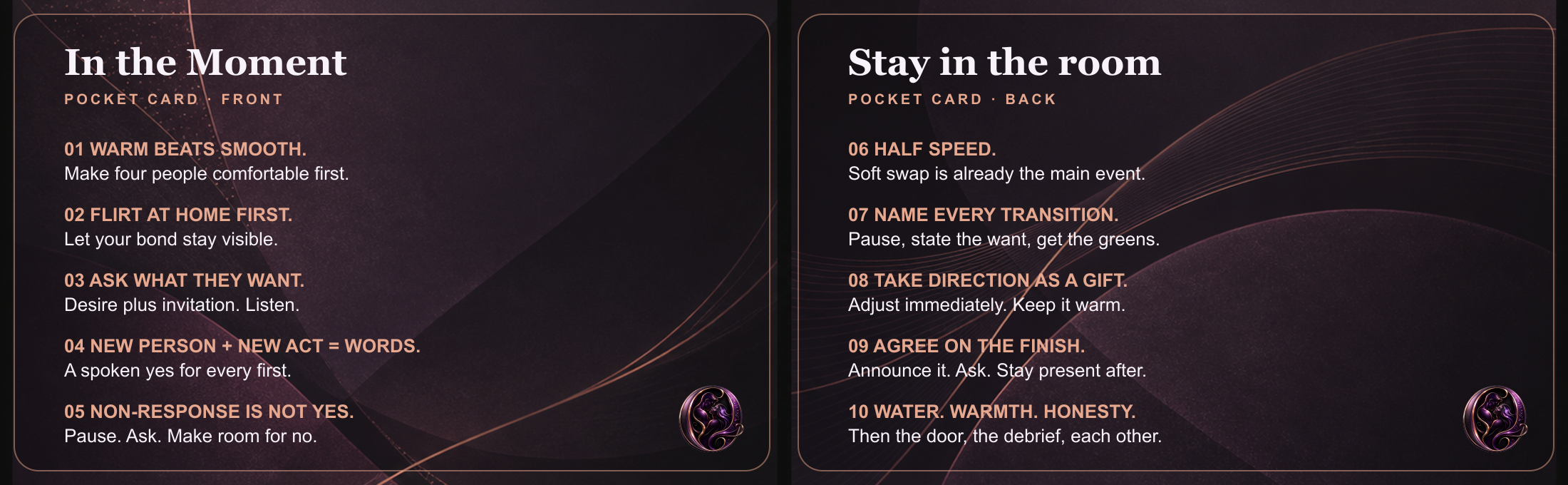
The Pocket Card
Everything above, distilled to what you can keep in your head tonight:

Front · Arrive and ask
In the Moment
- Warm beats smooth. Make four people comfortable first.
- Flirt with your own partner first. Let your bond stay visible.
- Ask what they want. Desire plus invitation. Listen.
- New person + new act = words. A spoken yes for every first.
- Non-response is not yes. Pause, ask, and make room for no.
Back · Stay in the room
Keep choosing
- Half speed. Soft swap is already the main event.
- Name every transition. Pause, state the want, get the greens.
- Take direction as a gift. Adjust immediately and keep it warm.
- Agree on the finish. Announce it, ask, and stay present after.
- Water. Warmth. Honesty. Then the door, the debrief, and each other.
Download the discreet pocket cardPNG · front and back together · suitable for saving or printing
A Final Word
You Are Ready
You now hold the complete arc of the night — from the first charged minutes on the sectional, through the slow closing of space, the territory of mouths and hands, the optional crossing into protected penetration, the finish, the clean-up, the care, and the exact language that keeps unscripted moments from becoming ruptures.
Read this guide together once more if it helps. Say a few of the lines out loud so they live in the air between you — you'll be surprised which ones make you both grin, and which ones make the room feel suddenly warmer. Confirm your signals one last time. Then put the pages away.
Because here is the truth underneath all of it: the couples who leave these evenings glowing are rarely the ones who executed a perfect sequence. They're the ones who stayed honest when the sequence broke, laughed when bodies were ridiculous, protected every boundary that was named, and took care of each other after the heat receded. You already did the hardest work before this page began — the private conversations, the green light given to each other. Everything that follows is simply the practice of staying honest once other bodies are in the room.
When the doorbell rings and the air thickens, you won't need to remember every sentence. You'll only need to stay present with the people in front of you — including each other. The nerves you're feeling right now aren't a warning. They're anticipation wearing a disguise, and the moment someone is brave enough to say the first true sentence out loud, the disguise comes off.
Be the brave one. You know the words now.
Go be kind to each other in the heat.
“Breathe. The journey, not the end, is the pleasure. Go at your own pace—and respect the pace of others.”— Amanda
“Relax. Demand respect—of your persons and your home. Enjoy.”— Peter